Keeping Stock Rolls Distinct with a Rubber Conveyor Belt Supplier

Two black belt rolls arrive together. Their widths look alike, and neither looks unusual through the wrapping. For a distributor, that resemblance is precisely the danger: a rubber conveyor belt supplier may be supplying different reinforcement and cover constructions for different machines. Start with GRAM’s rubber conveyor belt range, then keep the construction, approved duty and destination attached to each roll. The first stocking decision is whether two belts are genuinely interchangeable, not whether they fit on the same shelf.
A quarry replacement buyer and a regional parts distributor approach this problem differently. The quarry needs one belt to match a particular conveyor. The distributor may hold several constructions for different customers and cut them into shorter lengths later. Both need an identity that survives receiving, storage, cutting and dispatch. Colour and outside appearance cannot provide that identity.
Ask the Rubber Conveyor Belt Supplier to Separate Cover and Carcass Identity
Rubber describes the working and protective surfaces of many industrial conveyor belts. It does not identify the reinforcement carrying the longitudinal tension. GRAM’s product families include fabric-reinforced and steel-cord belts, with separate EP, NN and heat-resistant routes. Write those distinctions into the stock description before comparing an available roll with the requested one.
EP Fabric and NN Fabric Belong on Different Stock Lines
GRAM’s EP rubber belt construction uses polyester in the longitudinal fabric direction and nylon in the transverse direction. Its described arrangement includes a top rubber cover, fabric carcass and bottom rubber cover. The NN rubber belt family uses nylon in both fabric directions. These are construction identities, not complete approval specifications.
An EP designation does not establish the number of plies, cover thickness, belt width or suitable pulley arrangement for every order. Likewise, an NN label does not make all NN belts equivalent. A distributor should keep the full approved construction beside the family name. Otherwise an operator can select the correct material abbreviation while still receiving the wrong belt for the machine.
Imagine two aggregate plants requesting a similar width but retaining different pulley layouts and tensioning equipment. Their rolls should remain separately assigned until the complete constructions have been approved for both installations. Consolidating those orders simply because both requests say “rubber belt” removes information needed for the final selection.
A Steel-cord Belt Is Not a Stronger Version of the Same Fabric Stock
GRAM’s steel-cord conveyor belts use longitudinal steel reinforcement. Changing from fabric to steel cord affects more than the wording on an inventory line. The proposed splice system, belt construction and compatibility with retained equipment need their own engineering agreement.
If a purchasing agent is offered a steel-cord roll because it is available, its tensile reinforcement should not be treated as permission to substitute it for a fabric belt. The installation team must know what joint construction will be required and whether the conveyor has been assessed for that belt. An apparently favourable strength description can create a replacement that the planned joining operation cannot use.
Keep steel-cord stock identifiable without opening or damaging the protective wrapping. A reference to the reinforcement and the approved order documents is more useful than an informal description such as “the heavy black roll.” If a retained sample accompanies the order, label it with the same reference and its intended comparison purpose.

The Rubber Conveyor Belt Supplier Should Name the Intended Cover Duty
The carcass and covers answer different questions. A reinforcement label identifies the structural route; a cover description addresses the material contact and operating exposure. Neither can safely replace the other in a distributor’s stock record. A complete proposal should describe both before a roll is reserved for a customer.
Heat-resistant Rubber Stock Needs Its Own Application Limits
GRAM lists HR rubber belts separately. That provides a product route for reviewing a hot-material application, but it does not establish the permissible temperature for an unidentified roll. The buyer still needs the proposed cover construction and its stated operating limits.
For a cement maintenance order, record the exposure the supplier must evaluate: the material condition, whether loading is intermittent, the contact pattern and the conveyor’s actual operation. A roll reserved for that duty should not lose its cover identity when placed beside a general replacement belt. Conversely, a fabric carcass name should not be taken as proof that its covers are suitable for hot material.
The useful stock distinction is the approved application and supporting document, not an invented universal heat category. If a customer asks to use the same roll on another hot conveyor, compare the second duty with those limits rather than relying on the fact that both plants handle clinker or ash.
Continental’s textile belt overview also distinguishes fabric constructions and cover options. Its products and performance claims belong to Continental. The general purchasing principle is simply to retain separate descriptions of reinforcement and covers when identifying a complete belt.
Black Rubber Appearance Does Not Confirm Oil or Chemical Suitability
A distributor may receive a request to move a reserved roll from an aggregate conveyor to a line exposed to oily material. The outside colour cannot resolve that change. Identify the actual contact substance, temperature and exposure, then obtain confirmation for the proposed rubber compound. Do not extend one approved application into a blanket resistance claim.
Where the required compound is not identified in the available documents, keep the substitution unapproved. A purchasing delay is visible; an unsuitable cover can remain unnoticed until after the roll has been cut and fitted. The stock record should make that unresolved compatibility question explicit rather than conceal it inside a broad product description.
Reserve Replacement Rolls by Conveyor Duty, Not Only by Width
Width is easy to compare in a warehouse, but it is only one part of the installation decision. Retain the ordered length, reinforcement, ply or cord construction, cover details and joining requirement with the machine reference. Any difference between requested and offered construction should be reviewed before the stock allocation is released.
For a regional distributor serving several quarry operators, an order number alone may be insufficient if the same customer owns several conveyors. Add the conveyor identifier or agreed equipment description. That prevents a perfectly legitimate roll for one position from becoming an apparently approved spare for every line at the same site.
A replacement reserve also needs a clear distinction between uncut roll length and usable installation length. The joining method may require material beyond the operating belt length. Let the joining plan determine the allowance; do not apply an arbitrary allowance to all fabric and steel-cord constructions. Keep the approved cutting instruction attached to the reserve.
- Construction reference
- Identify EP, NN or steel cord together with the actual ordered construction and cover description.
- Destination reference
- Identify the customer’s conveyor and the application against which that construction was approved.
- Cutting reference
- Preserve the agreed usable length, joining allowance and direction or surface information relevant to that belt.
- Release reference
- Record whether an offered alternative is approved, pending technical review or unsuitable for the intended position.
These references should remain linked rather than live in separate conversations. A short stock label can point to the complete order record; it does not need to reproduce an engineering file. What matters is that staff can retrieve the correct file without guessing which of several similar rolls the label means.
Preserve Belt Identification When Wrapping Is Opened or Material Is Cut
Opening a roll changes the information boundary. A supplier’s label may remain on the outside wrapping while a cut section moves to another area. Before cutting, identify how the cut piece and remaining roll will retain their connection to the approved construction. This is particularly important when one received roll supplies several replacement lengths.
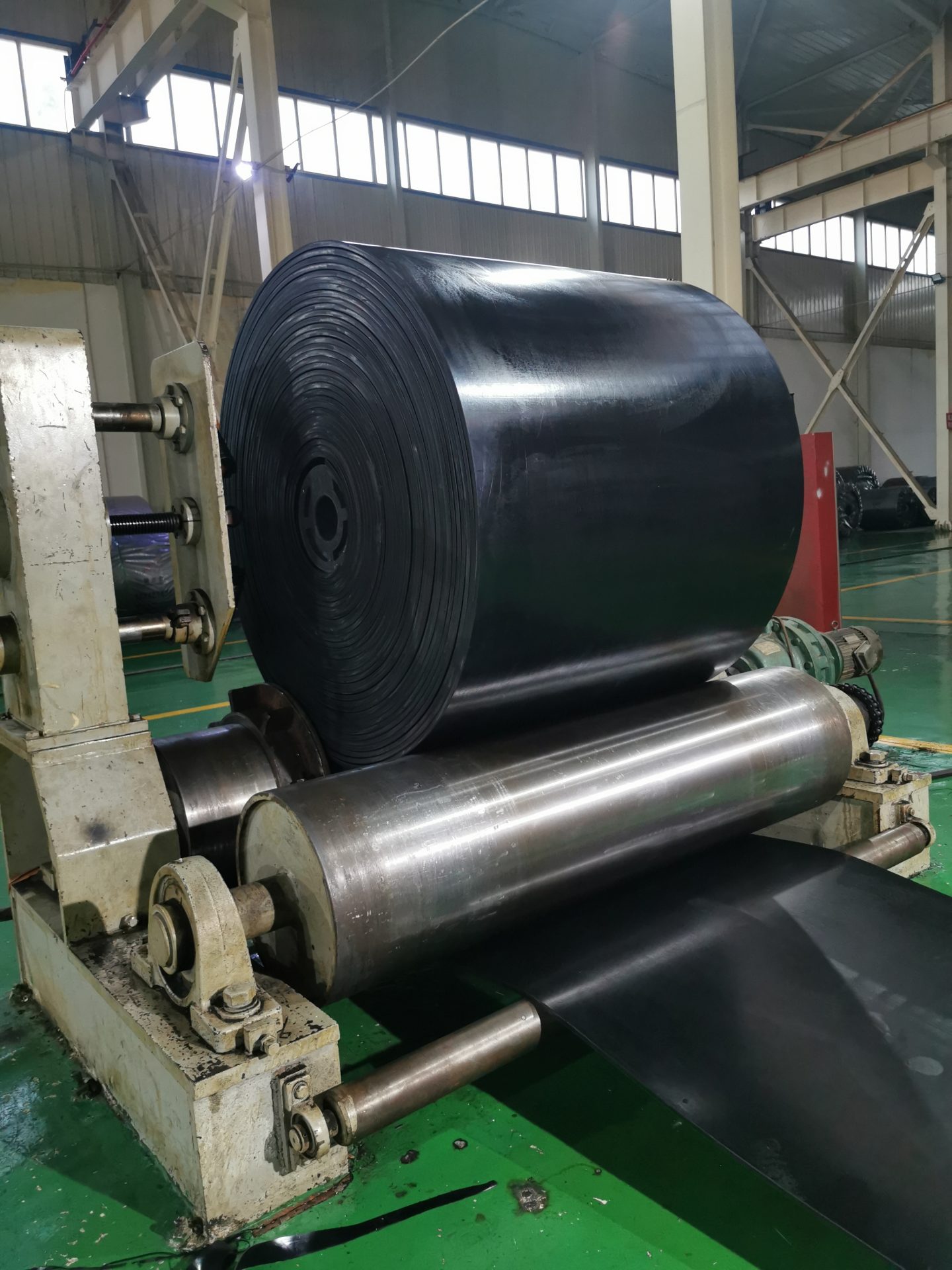
The photograph illustrates belt handling equipment, not a prescribed cutting or lifting method. Use the roll’s actual mass, support arrangement and handling instructions to plan movement. A picture of a similar roll does not establish the lifting equipment, core capacity or safe restraint for the received consignment.
Before dispatching a cut piece, check that the paperwork describes the piece being supplied rather than the original total roll. Keep any remaining length distinguishable from a new full roll. If measuring or cutting changes the available length, update the reserve immediately so another customer is not promised material that has already been allocated.
Where the top and bottom covers differ, retain the agreed working-face identification on the cutting and installation documents. A loosely rolled piece can be turned during handling, and appearance alone may not reliably distinguish its two faces. Ask how the supplied belt identifies the carrying surface and how that identification should be preserved after cutting. A receiving team should not create its own interpretation from surface shine or from which side happens to face outward on the pallet.
This is especially relevant when a distributor supplies a fabric belt section to an installer who did not receive the original roll. Send the approved construction reference and face information with that section, not only with the warehouse copy of the delivery note.
A distributor should also separate visible receiving damage from an approved manufacturing feature. A crushed edge, damaged wrapping or evidence of an unsupported roll warrants a recorded inspection against the supply documents. Do not automatically accept it as harmless merely because the centre of the belt surface looks undamaged.
For transport, agree which part of the roll the proposed supports and restraints contact. The arrangement should avoid creating local damage to edges or covers and should remain compatible with the roll’s intended handling method. These are order-specific packing requirements to agree with the supplier, not a claim that every belt family is delivered in one standard package.
Fabric Belt Cut Ends Should Retain Their Construction Reference
An exposed cut end may help a qualified inspector compare the received construction with the order, but it is not a substitute for the specified technical record. Preserve a clearly identified sample if the inspection or joining agreement calls for one. Do not remove material needed for the installation simply to create an informal demonstration sample.
If the original roll is split for two orders, a sample from one end should not become evidence for another construction stored nearby. Keep the sample reference, cut-piece reference and supplier’s document reference together. This avoids a deceptively convincing acceptance discussion built around the wrong piece of belt.
An Available Rubber Belt Roll Still Needs Substitution Approval
Urgent orders create pressure to treat availability as suitability. A plant buyer may accept an alternate roll because production has stopped, while the distributor assumes that matching width is enough. Name every changed part of the construction and ask the responsible engineer to assess its consequence for the actual machine.
GRAM’s existing explanation of rubber belt cover grades helps frame the cover discussion. Use it alongside the actual order proposal; general guidance cannot approve an unnamed stock roll or replace construction-specific compatibility evidence.
Reserve the roll only after its identity and intended destination agree. If its reinforcement, cover duty or joining requirement remains uncertain, keep it separate from the customer’s approved spare. The most useful stocked belt is the one the receiving team can identify and the installation team can use for the agreed conveyor without discovering a hidden substitution after cutting.
Last Updated on October 2, 2026 by gramconveyor_admin


