
Discuss Sharp Fragments with a Stone Crusher Conveyor Belt Supplier Before Adding Cover Thickness

A deep isolated cut and a gradually thinning cover point to different purchasing questions. Before asking a stone crusher conveyor belt supplier for a thicker replacement, a quarry buyer should describe the damage pattern, material entry and retained conveyor arrangement. GRAM’s rubber conveyor belt range includes stone handling and provides EP, NN and steel-cord routes to compare. Start with the belt’s actual mechanical specification and what the crusher discharge puts onto its working surface.
This guide suits crusher contractors, quarry maintenance teams and buyers replacing belts after sharp-fragment damage. First separate continuous abrasive wear from localized cutting, puncture or contact with the surrounding equipment. A replacement needs an appropriate cover and reinforcement, but it should not be expected to correct an unresolved chute or support problem.
A stone crusher conveyor belt supplier needs the damage pattern
Photographs of the isolated belt and a description of where the damage occurs can make the enquiry more useful. Mark the belt direction, loading position and location across the width. State whether the damage appeared repeatedly at one point or gradually across the working surface. Avoid naming a failure mechanism before the plant’s inspection supports it.
Sharp-fragment cuts are different from ordinary cover abrasion
A cover can wear gradually while carrying abrasive stone. A localized cut can involve a different contact, such as a sharp fragment or an unintended equipment interface. The buyer should not treat both as proof that the original cover was simply too thin. Describe the observed damage and have the operating arrangement reviewed.
A crusher contractor finding isolated cuts on a relatively new belt should inspect the relevant transfer and surrounding contact under the site’s approved procedure. Record any unusual fragments and changes in the discharge arrangement. This gives the supplier a factual basis for discussing the offered cover instead of asking it to make an unsupported cut-proof promise.
Puncture or tearing should not be hidden inside an abrasion requirement
Identify whether the damage extends into the reinforcement or remains on the cover. That distinction affects how the replacement is assessed and whether the existing belt can remain in service under the plant’s approved decision. A generic abrasion-resistant description does not establish resistance to every localized penetrating load.
If a project requires evidence for a particular cutting or tearing condition, put that requirement in the enquiry and obtain applicable product-specific documentation. Do not use an abrasion test result as proof of an unrelated damage mechanism. The test method and the offered construction must correspond to the property being evaluated.
| Observed condition | Evidence to give the supplier | Decision that still needs review |
|---|---|---|
| General surface wear | Location and progression across the cover | Offered cover suitability for abrasive stone |
| Isolated cuts | Damage position and sharp material condition | Material entry and relevant cover evidence |
| Edge damage | Belt location and nearby contact geometry | Transfer, tracking and equipment clearance |
| Reinforcement damage | Inspection findings and original belt construction | Approved service decision and replacement carcass |
Stone crusher belt selection must keep the carcass specification clear
GRAM’s EP rubber belt uses polyester warp and nylon weft, while its NN rubber belt uses nylon in both directions. These are different fabric constructions. Neither name establishes the complete reinforcement strength, cover arrangement or finished belt requirement on its own.
EP and NN offers should match the retained pulley and tension requirements
Provide the existing conveyor specification and identify which elements remain unchanged. If the proposed replacement changes reinforcement or overall construction, have the system requirements reviewed. A fabric name cannot establish compatibility with every pulley, take-up arrangement or joining method.
Do not identify the internal fabric by the belt’s external color. If the original specification is missing, obtain the equipment records or a suitable assessment of the sample. The purchase should end with a declared offered construction, not an informal instruction to provide another black crusher belt.
Steel-cord reinforcement does not eliminate sharp-fragment risk
GRAM’s steel-cord conveyor belt range describes longitudinal steel reinforcement for demanding conveying. That is a mechanical construction route to evaluate where the approved conveyor duty requires it. It is not a blanket guarantee against cutting, puncture or tearing.
The cover still meets the material, and the complete belt still needs an appropriate installation and splice. If a buyer considers moving from fabric to steel cord, that change should follow the conveyor designer’s assessment. Do not select the reinforcement only because the word steel sounds more resistant to sharp stone.

Review the crusher discharge before increasing cover thickness
A quarry buyer considering a thicker cover should have the retained loading arrangement assessed at the same time. The belt must fit and operate within the approved pulley, support and clearance conditions. A construction change should not be made without understanding those interfaces.
Rubber-ring impact rollers support a different duty from normal carrying rollers
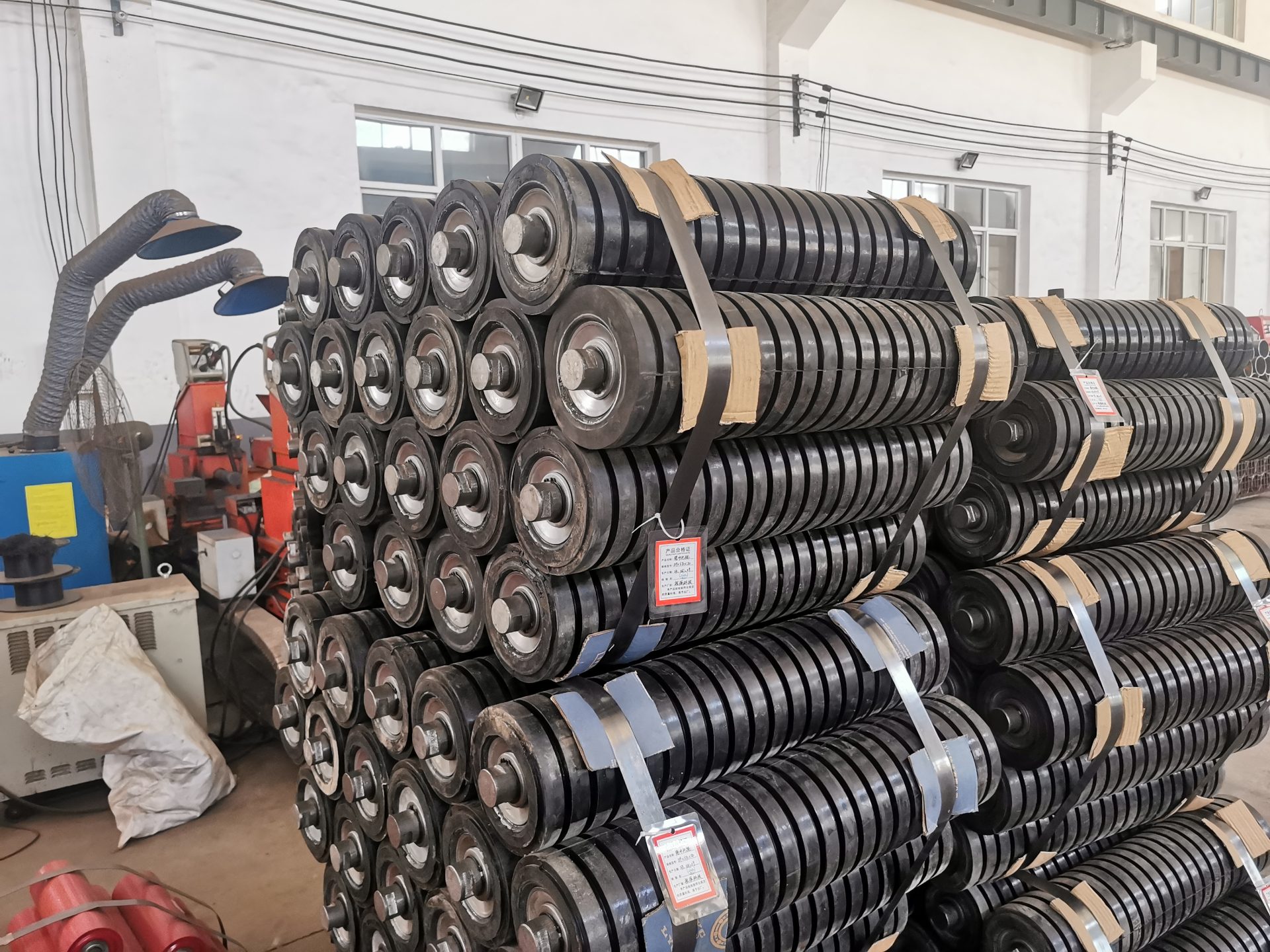
GRAM’s impact rollers use rubber-ring working surfaces at loading zones. Their role should be reviewed against the actual material landing condition. The belt and support enquiries should share the same description of the crusher discharge rather than being evaluated separately with different assumptions.
If the rock stream has moved after a chute alteration, establish whether the support still lies beneath the relevant landing region. A new belt cover cannot determine that position. The responsible project team should coordinate the transfer and support changes before the replacement belt is accepted.
Build the crusher belt offer around the required evidence
Ask for the actual cover and reinforcement proposed for the stated duty. If the project specifies a test or grade, obtain the corresponding documentation for that offered belt. A general durability statement does not establish a measured result or prove that the cover meets the site’s required acceptance criterion.
Dunlop’s conveyor belt range literature distinguishes reinforcement constructions and cover duties. It supports the general principle that those requirements should be kept explicit. Dunlop’s grades, test figures and product claims are not GRAM performance data.
The quarry belt selection discussion is relevant when one plant contains several material-transfer conditions. Keep the crusher-discharge damage description specific to this conveyor rather than allowing a general quarry application label to replace it.
Mixed feed should be described before the crusher belt is reordered
Occasional sharp or unusual material can matter even when most of the feed is ordinary stone. Identify what the plant’s process can credibly put onto the belt and which upstream controls are part of the approved arrangement. The belt supplier should receive that operating boundary. Do not claim the replacement is suitable for uncontrolled debris that has never been assessed.
If the plant changes its feed or crusher operating arrangement, update the next enquiry. The old belt’s mounting and route dimensions may remain correct while the cover duty changes. Keeping the current material description with the approved construction prevents a repeat order from preserving an obsolete service assumption.
Keep crusher replacement construction changes visible before shutdown
The replacement offer should identify what has changed from the damaged crusher belt
A buyer comparing a thicker proposed cover with the old belt should ask which other construction details remain unchanged. The offered reinforcement, overall arrangement and applicable joining information need to be clear. If the supplier changes more than the cover, have the complete proposal assessed against the retained conveyor rather than treating it as a like-for-like surface upgrade.
For a phased quarry repair, identify whether the chute, support or neighboring conveyor interfaces will be renewed before the belt enters service. The supplier needs the intended operating arrangement, while the project team coordinates those retained and changed components. A belt selected for a corrected transfer should not be accepted under the old damaging condition without review.
A distributor holding emergency crusher-belt stock should preserve the customer’s approved cover and reinforcement description. Two rolls with the same width can have different constructions. An urgent request should not turn a conveniently available black rubber roll into an assumed equivalent. Assess any substitute against the mechanical specification and the current sharp-material exposure.
If the original damage investigation remains incomplete, state what is known and what still needs engineering confirmation. The buyer can progress the dimensional and delivery enquiry while retaining the unresolved cover or transfer requirement. That is more useful than asking the supplier for an unsupported assurance that the next belt cannot be cut.
Specify the required width, delivered length, reinforcement and cover arrangement, together with the agreed supply form. Identify whether the order concerns an open length or a completed loop and who performs the joining. The joining requirement should be coordinated with the chosen construction before the final length is approved.
At delivery, compare the belt identification and supplied documents with that approved record. Inspect visible cover and edge damage before installation, following the agreed handling procedure. Arrange packing and package size around the actual belt and site’s handling access; do not assume a generic reel can reach every crusher location.
Make the replacement decision answer the damage that was actually found. Use cover evidence for the material-contact duty, carcass information for the mechanical requirement and a transfer review for the loading condition. If the sharp-fragment problem remains undefined, more cover thickness is still an assumption rather than an approved solution.
Last Updated on October 3, 2026 by gramconveyor_admin


