
Reassigning Belt Positions with a Quarry Conveyor Belt Supplier After a Plant Move

After a quarry processing train moves, a familiar conveyor may no longer perform its familiar job. The belt once taking a screened product to a stockpile may now receive another fraction, a different transfer or an inclined route. A quarry conveyor belt supplier should receive the new position description before the buyer repeats the old belt order. GRAM’s EP rubber belts provide one construction route, but the retained conveyor and its revised duty must establish what the replacement actually needs.
A quarry conveyor belt supplier should quote the moved plant’s current arrangement
Keep the former conveyor reference if it helps identify the equipment, but attach its current process position. State what feeds it now and where it discharges. A historical name can remain useful for maintenance while becoming misleading for purchasing, especially when several conveyors are moved and reconnected during the same project.
A contractor receiving a request for the “old product belt” should establish which equipment that label describes after relocation. The desired GRAM construction should follow the current conveyor arrangement and accepted operating duty. A belt that served the previous position is evidence of the old application, not automatic approval for the revised route.
The new transfer belongs with the EP belt proposal
GRAM’s EP construction uses polyester yarns longitudinally and nylon yarns transversely. This describes its reinforcement arrangement, but it does not define the new transfer impact or the required cover for every quarry position. Include the proposed feed and retained loading support when reviewing the EP offer.
Where a plant move changes the receiving point, the new transfer can become the relevant duty even if the conveyor frame and nominal belt width remain the same. The buyer should preserve that change in the order discussion. Repeating the previous reinforcement description alone would leave the revised loading condition outside the supplier’s assessment.
Separate quarry belt reinforcement from the cover needed at the new position
GRAM’s rubber conveyor belt range distinguishes rubber-covered constructions from their reinforcement routes. A purchasing description should retain both parts of the intended belt. The outer cover answers a different question from the fabric name, and neither can be inferred merely from the black appearance of a retained belt.
A quarry may reuse conveyors across coarse feed, screened product and a changed stockpile arrangement. Do not assume that the most severe duty should define every replacement on the purchase order. Each accepted construction should be connected to the material and equipment at its actual position, so a consolidated order does not obscure the differences between the lines.
For example, moving a retained conveyor from a screened-product position to a receiving position changes the material description used to assess its cover. The EP or NN reinforcement proposal should remain connected to that revised duty, with the actual cover requirement identified separately. A supplier should not retain the previous construction solely because its purchasing reference still names the old product stream. Conversely, a conveyor reassigned to a different screened fraction should receive its own assessment rather than automatically inherit the cover proposal made for the coarse receiving line.
An NN alternative requires a new construction decision
GRAM’s NN rubber belts use nylon in both fabric directions. That is a real difference from EP’s yarn arrangement, not another name for the same reinforcement. If an NN alternative is proposed for a moved conveyor, assess the complete construction against the retained equipment and revised duty.
The supplier should identify what changes from the accepted EP proposal, including the actual reinforcement specification and belt build offered for the order. Do not approve the substitution solely because the belt width and overall thickness appear similar. Those outer dimensions do not establish identical reinforcement behaviour or equipment compatibility.
Likewise, a previous NN belt does not establish that every moved conveyor needs NN. Keep its former position and service condition recognizable, then assess whether the proposed new duty supports retaining that construction. The useful discussion is about an identifiable belt and conveyor combination, rather than a general claim that one fabric is always preferable in quarry work.
A new incline changes the profiled-belt question
GRAM’s fabric belt range includes photographed belts with raised angled profile elements above a base belt. These show a profiled construction route that can be discussed when a revised conveyor position includes an incline. They do not establish a permissible angle, profile height or capacity for the actual installation.
If a plant move introduces a different incline, give the supplier the accepted conveyor geometry and actual material description. The proposed profile must be identified against that duty. Simply adding a raised pattern to the previous belt description would leave the base construction, retained equipment and complete belt path unresolved.
Raised profiles do not replace the base-belt specification
The profile and the belt beneath it perform different parts of the conveying function. Keep the offered reinforcement, covers and profile arrangement distinguishable in the proposal. A photograph can show the visible raised surface while saying little about the unseen fabric construction that will be supplied.
For a contractor ordering a replacement after relocation, identify whether the retained return supports and cleaning arrangement were assessed for the proposed profile. This is a compatibility question for the actual conveyor; it is not permission to borrow a profile height or operating angle from another manufacturer’s catalogue.

Rubber-ring impact rollers should follow the revised receiving duty
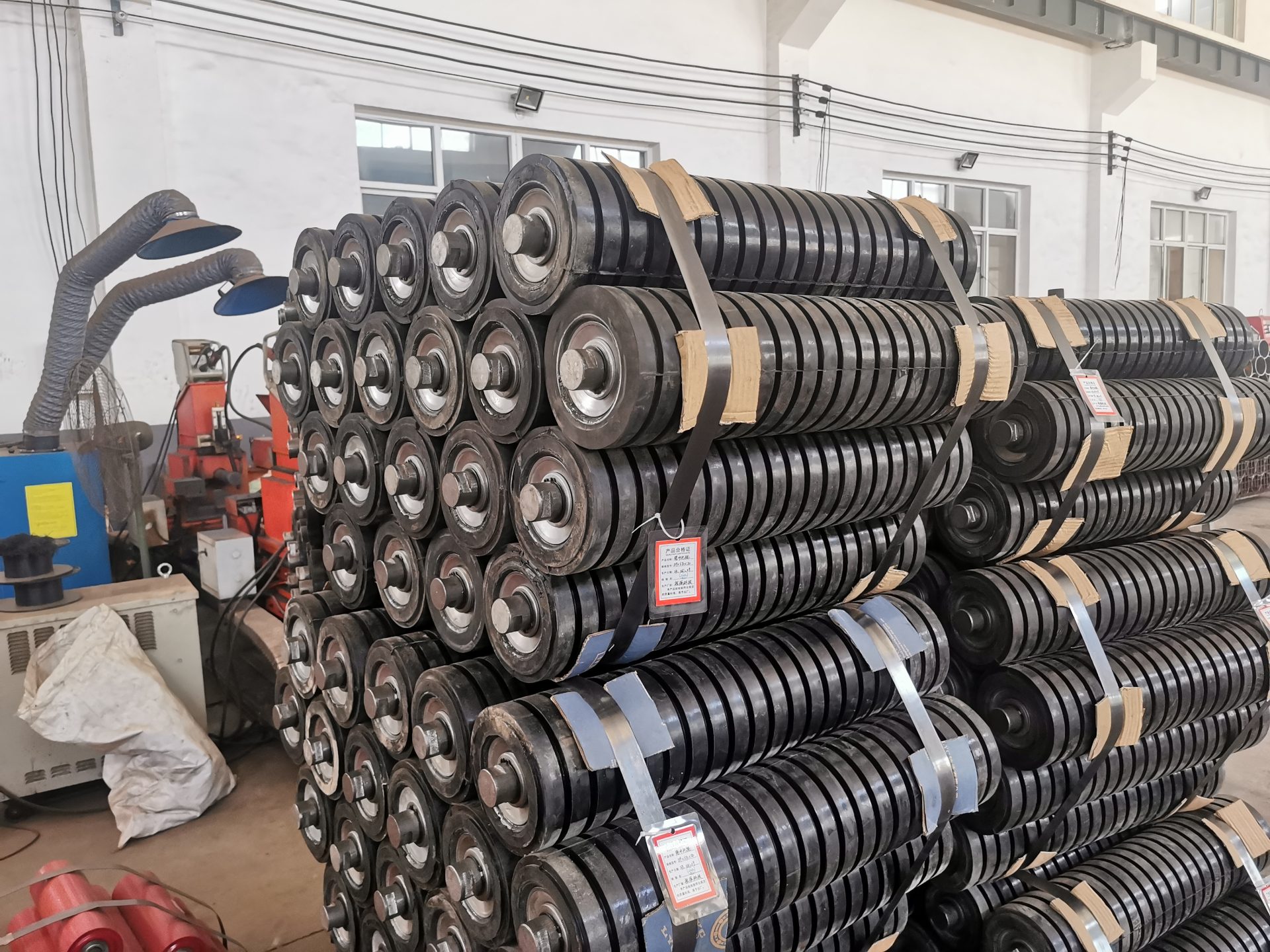
The moved conveyor may retain its belt-support frame while receiving material at a different point. GRAM’s rubber-ring impact rollers are a distinct loading-support route. Their ringed working surfaces should be assessed as part of the proposed transfer arrangement rather than included automatically in every quarry replacement order.
If the new layout relocates the landing area, identify which support assemblies will remain and which are proposed for replacement. A component that was correctly assigned to the former loading position can be poorly described if the order continues using the old location after the plant move. The proposal should show the intended final position.
The impact roller’s working body differs from a smooth support roller
The rubber rings visible on GRAM impact rollers form the belt-contacting construction being considered. Keep that working surface separate from the shaft and retained bracket interface. An assembly needs both a defined contact duty and an accepted installation relationship; a matching shaft alone does not answer the changed loading question.
Where impact rollers and belts are supplied together, identify their separate accepted specifications. The belt construction does not provide a roller load rating, and the ringed roller description does not provide a belt impact guarantee. Keeping the two supply items connected to the transfer while retaining their own approval boundaries makes the combined offer easier to evaluate.
Compare revised quarry belt offers against the same final layout
A buyer can receive one offer based on the former plant arrangement and another based on the revised drawing. Their product descriptions may look similar while their application assumptions differ. Establish which conveyor position, material stream and retained interfaces each proposal uses before comparing the offered GRAM constructions.
For each belt, identify the current conveyor reference, proposed reinforcement, cover requirement and any raised profile. For the loading support, preserve the intended assembly position and its interface with the retained structure. These are specific parts of the revised project, rather than a general procurement list that treats every conveyor as the same.
The supplier’s delivered identification should follow the accepted current references. If an old label is retained for continuity, show its relationship to the new duty clearly. A receiving team should not have to decide which of two superficially similar belt rolls was intended for the newly inclined position.
A last-minute belt substitution must retain the new duty reference
If the supplier proposes another available construction, require the alternative to remain tied to the same revised conveyor. The new material stream and retained interfaces do not disappear when the purchasing discussion turns to delivery. Identify the changed reinforcement, cover or profile and obtain the appropriate application acceptance before treating the offer as equivalent.
No GRAM stock quantity or delivery period follows from that recommendation. The actual supply proposal must confirm availability and delivery-unit details for the accepted belt. The buyer’s task is to preserve the revised duty while considering an alternative, rather than assume that a roll of convenient dimensions is automatically suitable.
Keep the relocation drawing attached until the belt order is released
Continental’s textile belt overview illustrates why reinforcement and cover construction remain distinct selection inputs across bulk-handling applications. Its product names and performance claims are not GRAM specifications. Use the general construction distinction to improve the inquiry, while keeping the actual offer grounded in GRAM’s identified routes.
The broader mine and quarry belt selection discussion remains useful for the overall project. For a relocated plant, add the current position references and the changes that justify reconsidering each retained conveyor. Those changes should remain visible through supplier review, accepted drawings and delivery identification.
Release the belt order against the processing train that will actually operate after the move. Keep the previous construction as a reference where useful, but make the revised material, incline and loading support the basis of acceptance. That lets the receiving team place the supplied belt in its intended job without having to reconstruct the plant’s former layout.
Last Updated on October 3, 2026 by gramconveyor_admin


